

On the floor of the Atlantic Ocean near Brazil, researchers have discovered traces of an ancient tropical island that submerged millions of years ago, leaving behind a unique geological record and rich deposits of rare earth metals.
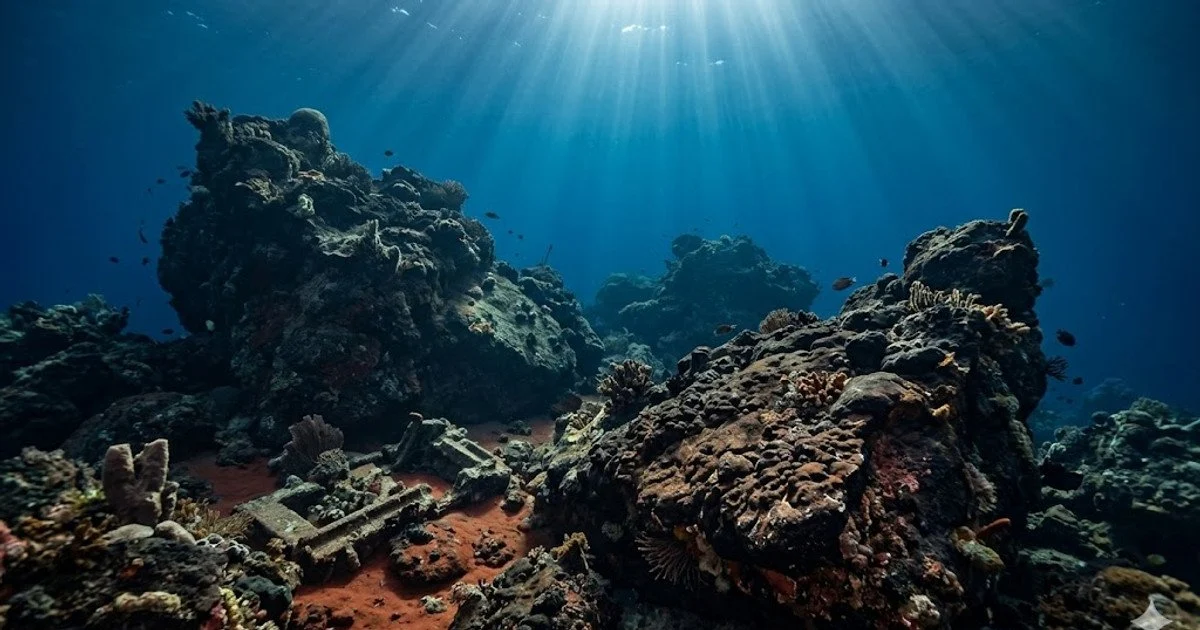
A tropical island rich in rare earth metal deposits sank millions of years ago
A vast volcanic plateau, hidden beneath the waters of the South Atlantic, was once a true tropical island that gradually descended to the ocean floor.
Daily Galaxy reports on the unexpected geological discovery that reveals new details about our planet’s past.
A Discovery That Shouldn’t Exist
The Rio Grande Rise is located approximately 1,200 kilometers off the coast of Brazil. Scientists have known about this underwater formation for decades, but its true history began to unfold only in 2018. At that time, a team of researchers from Brazil and Great Britain, studying the western part of the plateau, found something completely unexpected among layers of volcanic lava – red clay. As noted by marine geologist Bramley M. of the National Oceanography Centre in Southampton, such deposits are simply not found on the seabed, as they are characteristic exclusively of tropical soils.
After years of further research, scientists concluded that this clay formed when the area was exposed to open air. According to research published in Scientific Reports, this part of the Rio Grande Rise stood above sea level between 44 and 47 million years ago (during the Eocene epoch) as a classic volcanic island.
Evidence of a Tropical Landscape
Scientists have found several compelling pieces of evidence that island life once thrived where the modern ocean floor now lies:
-
Mineral Composition: Kaolinite, hematite, and goethite were found in the red clay – minerals formed as a result of intense weathering exclusively in a warm and humid climate.
-
Similarity to the Mainland: Co-author of the study, Luigi Jovane from the University of São Paulo, explained that chemically and mineralogically, these clays are identical to the red earth (terra roxa) widespread in Brazil. This indicates a direct climatic connection between the island and the continent.
-
High Chemical Index of Alteration (CIA): A value of 93 confirms that the rocks underwent extremely prolonged tropical weathering after volcanic activity ceased, before the island gradually sank.
A Geological Treasury and Rare Earth Metals
In addition to its scientific value, the Rio Grande Rise attracts immense attention due to its natural wealth, essential for modern industry.
Here are the valuable resources hidden on the submerged island:
-
Cobalt, Nickel, and Lithium: The plateau is covered with ferromanganese crusts rich in these metals, which are critically important for creating renewable energy infrastructure and energy storage technologies.
-
Yttrium: This rare earth element is indispensable in the production of aluminum and magnesium alloys, superconductors, lasers, LED lighting, and camera lens glass.
For researchers, the most surprising aspect remains that even millions of years after its disappearance into the depths of the Atlantic, this former island has preserved its unique geological record, which can now serve modern technologies.
We recall that for decades, it was believed that the Mediterranean Sea was formed by the most massive flood in Earth’s history, when the Atlantic waters broke through a land bridge. However, new findings on the seabed are forcing scientists to rewrite this Hollywood-scale disaster scenario, which, it seems, never actually happened.
Comments Sort: New Old Popular Send