

Under an asteroid crater, scientists have discovered evidence of ancient life that could alter our understanding of life’s origins on Earth. The finding suggests that celestial impacts not only destroyed but also created conditions for microbial development.
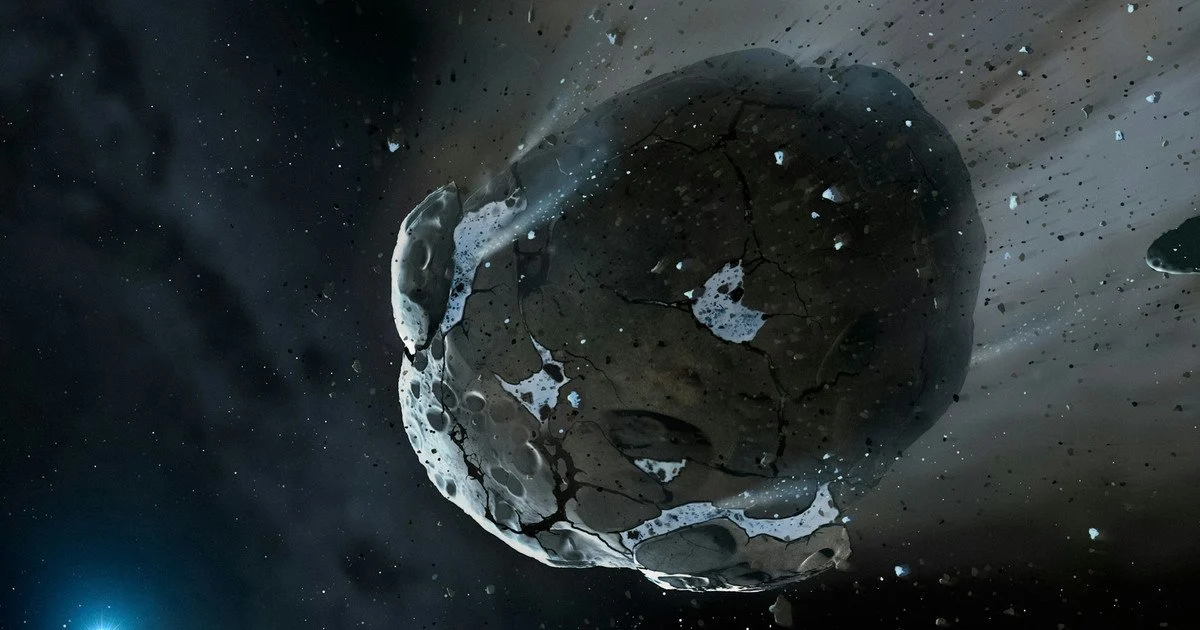
Asteroids may have created life on Earth / © Unsplash
Evidence of ancient life has been found beneath an asteroid crater. One theory for the emergence of life on Earth posits that life began after the planet was heavily bombarded by asteroids, approximately 4 billion years ago.
Scientists from South Korea have made a new discovery. According to this, the effect of asteroids might have been more complex than previously assumed. Science Alert reports on this.
Ancient Evidence of Life Discovered Under Asteroid Crater
Beneath a crater formed by a powerful impact roughly 42,000 years ago, a group of geologists led by Jes Lim from the Korea Institute of Geoscience and Mineral Resources (KIGAM) identified several stromatolites.
These are layered structures built by microbial mats, which resemble some of the oldest known evidence of life on Earth.
This discovery suggests that the heat generated during an impact could have fostered a long-lasting hydrothermal environment, similar to hot springs, where microbial communities could thrive.
It is entirely possible that during the era of intense asteroid bombardment billions of years ago, impact craters could have provided countless temporary refuges for early life forms on Earth.
The origin of life remains an obscure and still unknown story. However, a significant clue might be found in stromatolites, which have been discovered in various locations worldwide.
Currently, how stromatolites originated and spread is not understood. The Hapcheon Gun of Changnyeong Basin may have added a few more details. Although the basin is a well-known bowl-shaped structure on the Korean Peninsula’s landscape, its classification as an impact structure has only recently become known.
Further analyses revealed mineralogical evidence of meteorite material blending with terrestrial material within the basin, shedding light on how the impact occurred. Scientists determined that a large body of water once existed at this site.
Now, by excavating the northwestern part of the crater, scientists have unearthed numerous stromatolites ranging from 10 to 20 centimeters in diameter. It is already known that an impact crater can destroy and heat the Earth’s crust at the impact site. It is likely that these stromatolites formed in a hydrothermal lake created by asteroid impacts.
The team analyzed the mineral composition of the samples and detected traces of the element europium, which becomes significantly more soluble in hot hydrothermal fluids. Europium is typically interpreted as an indicator of past hydrothermal activity.
The theory is further supported by high levels of calcium, calcite, and sulfur associated with microbes adapted to hot environments, which were found in the sedimentary rocks.
Radiocarbon dating of one sample indicated that the stromatolites formed approximately between 23,400 and 14,600 years ago, suggesting the hydrothermal lake existed for several tens of thousands of years. This information helps us appreciate how long ago Earth may have been habitable.
Moreover, the study’s results imply that an asteroid collision could inadvertently create ideal conditions for microbial life.
Scientists now plan to investigate other impact craters, including those on Mars, to determine if life on Earth could have arisen from a combination of rare, unexplored components.
Latest Discoveries in the Study of Life’s Origins
As a reminder, a multidisciplinary team of scientists led by the Carnegie Institution for Science has developed a new methodology combining chemical analysis and machine learning to search for ancient life. An artificial intelligence model was trained to recognize unique chemical patterns that persist even after billions of years of geological changes.
Through this technology, AI identified chemical traces of biological origin in chert rocks from South Africa, dating back over 3.3 billion years. This discovery is nearly double the age of previously found reliable molecular evidence.
The AI model was trained on over 400 samples of modern plants, animals, fossils, and meteorites, achieving a 98% accuracy rate in distinguishing between materials of biological and abiotic origin.
The work is based on a law of nature proposed by the authors in 2023, which states that molecules of life are selected based on their functions and retain a unique distribution even after fragmentation.
Additionally, the research provided molecular evidence for the existence of oxygenic photosynthesis at least 2.52 billion years ago, extending its chemical record by over 800 million years.
Comments Sort: New Old Popular Send