

Ukraine and Russia are increasingly trying to exhaust each other with strikes on the economy, infrastructure, and strategic rear, which is why the war is taking on the features of a “total” war.
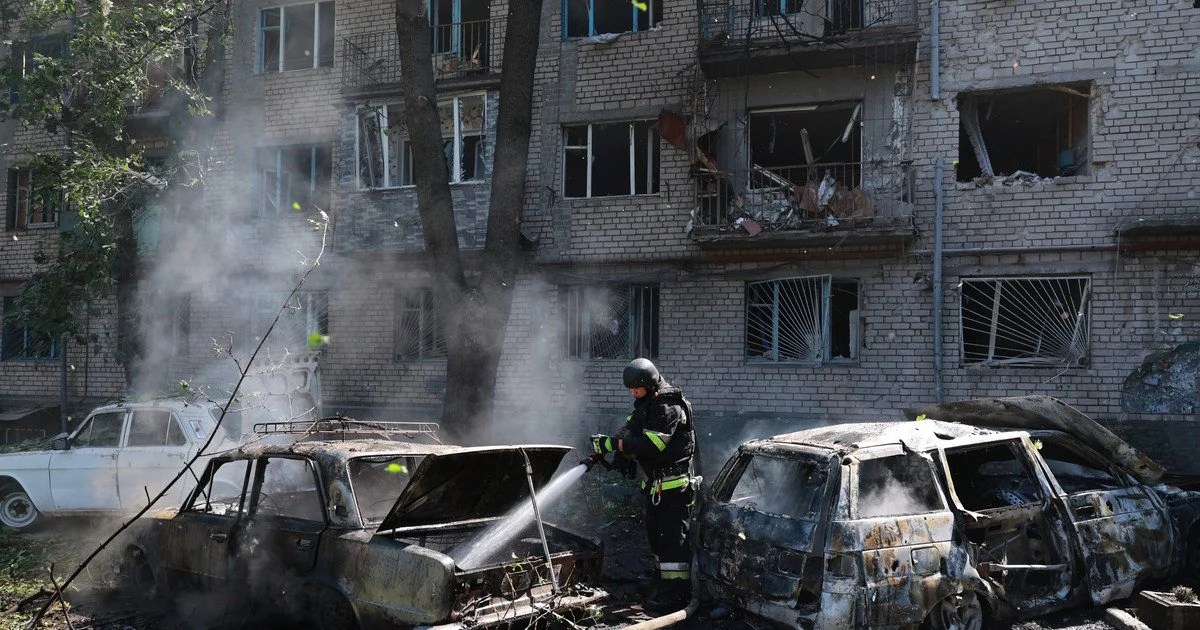
War in Ukraine / © Associated Press
Russia’s full-scale war against Ukraine is increasingly taking on the characteristics of a so-called total war, where the confrontation goes far beyond the front lines, and targets include the economy, infrastructure, and the state’s ability to continue fighting.
This is stated in a material by The Kyiv Independent.
The publication notes that the limitations that previously prevented discussions of a fully total nature of the war are gradually disappearing.
In the classical sense, total war means a conflict in which a state uses all available resources, and combat operations are directed not only against the enemy’s army. Military production, sources of income, logistics, critical infrastructure, and ultimately the society’s ability to continue the war are targeted.
As military analyst Mykola Bielieskov notes, the current confrontation increasingly resembles a classical total war adapted to modern technologies: the parties are trying to undermine the front by destroying vital infrastructure in the rear.
The war is increasingly shifting to the rear
One of the main signs of the new stage has been a sharp expansion of long-range strikes.
Ukraine has begun to strike more actively not only at military targets in the occupied territories but also at targets deep within Russia – oil refineries, energy export facilities, and warehouses. The Kyiv Independent calls this the emergence of strategic offensive pressure on Moscow outside the immediate front line.
During the “40-day operation of influence” announced by Volodymyr Zelenskyy, Ukraine also expanded attacks on Russian ports, tankers of the so-called shadow fleet in the Sea of Azov, and logistics-related facilities. According to the publication’s assessment, the economic impact of such strikes is already measured in billions of losses and intensifies the feeling of war among ordinary Russians.
Russia, in turn, responds with strikes on Ukrainian economy and rear infrastructure.
Trade and logistics facilities, including hypermarkets, supermarkets, postal and warehouse complexes, are increasingly coming under attack. Separately, Moscow has intensified strikes on port infrastructure and civilian cargo ships in the Odesa region.
These attacks have not only a direct destructive effect. Reduced shipping in the Black Sea threatens Ukraine with a loss of income from the export of grain and raw materials, which remain important for the country’s economy.
The goal is to force the enemy to break
Analysts cited by the publication see a similar strategic logic in the actions of both sides – to inflict such economic, social, and military losses on the enemy that it can no longer effectively continue the war.
“In other words, to bring the enemy to their knees before suffering their own defeat,” explains Bielieskov.
According to his assessment, Russia is placing a disproportionately larger bet on the destruction of vital Ukrainian infrastructure.
This poses a particular danger on the eve of winter. The Kyiv Independent warns that systematic Russian strikes on ports, enterprises, and critical infrastructure could lead to the classic effect of total war, where pressure is simultaneously exerted on the army, economy, population, and the state’s ability to function.
Escalation may only intensify
The publication notes that even without significant changes on the front line, the war may become increasingly total. If neither side is forced to make significant concessions, a growing part of the confrontation will shift to the enemy’s strategic rear.
A new wave of mobilization in Russia could become a separate factor. Moscow has so far tried to avoid large-scale conscription after the negative experience of 2022, but the shortage of personnel and the declining effectiveness of Russian troops have brought this issue back to the forefront.
If the Kremlin does go for a new mobilization, Russia will be able not only to intensify offensive operations but also to sustain them for a significantly longer period.
According to experts, this means that the war may enter an even longer phase of attrition, where the key question will be whose economy, army, infrastructure, and society will withstand the systemic pressure and destruction longer.
Notably, military expert Ivan Tymochko warned that on Ukraine’s Independence Day, Russia may intensify missile strikes or carry out sabotage due to the symbolic date. The expert noted that the state is preparing for such a scenario. He urged citizens to avoid large gatherings and be prepared for possible provocations and propaganda from the aggressor.
Related topics
War Russia Economy Comments Sort: New Old Popular Send