

Four years after the bloody terrorist attack in Olenivka: 93 Azov fighters still remain in Russian captivity.
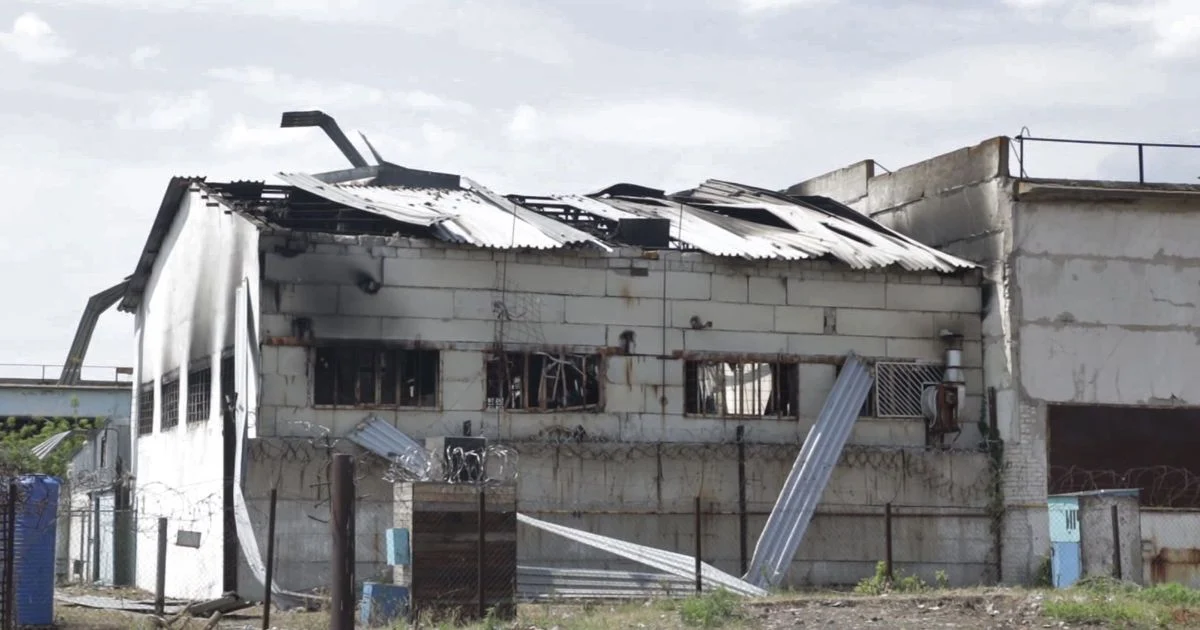
Olenivka / © Associated Press
Currently, over ninety fighters of the “Azov” brigade are still held in Russian prisons. After their capture, the Russians treacherously and defiantly attempted to kill them in the so-called “barrack No. 200” at the Olenivka penal colony.
Details about those who survived that bloody terrorist attack, and about those who tirelessly await their loved ones from captivity, are in a special report by TSN correspondent Maryana Bukhan.
The Story of Oleh Lobov: 4 Years in Russian Captivity
Anna Lobova has been waiting for her husband, Oleh, to be released from captivity for five years. Her husband is an Azov fighter who, during the fierce battles for Mariupol, first lost his twin brother (Vitaliy died during a complex redeployment to “Azovstal”), and in May 2022, along with the entire Mariupol garrison, surrendered into so-called honorable captivity by order of the higher command.
Like thousands of Ukrainian defenders, Oleh Lobov ended up in the horrific Olenivka penal colony. Two months into captivity, at the end of July 2022, the Russians suddenly relocated him and another 192 Azov fighters to a separate, isolated barrack on the adjacent industrial zone.
The Night of the Attack and a Planned Trap in “Barrack 200”
“Kraft,” an “Azov” brigade fighter: “I woke up directly from being wounded. I didn’t hear the explosion or the impact itself – I woke up from a burning, tearing pain in my abdomen. I think it was a piece of the metal roof… There were sharp metal fragments that went right through me.”
“Serhiy,” an “Azov” brigade fighter: “I woke up from just falling off the bed… Everything started collapsing from the roof, and I was partially buried by all of it, and I caught fire, I started burning. Everyone who was in the epicenter where I was – they all died before my eyes, just in a circle… I was just incredibly lucky.”
The Russians had prepared this mass terrorist attack in advance. To do this, the occupiers deliberately chose a separate building in the industrial zone, which was located apart and was not at all suitable for human habitation.
Dmytro, a former prisoner of war: “This barrack was completely overgrown with weeds. Inside, there were many machine tools and mechanical devices, and the entire floor was heavily coated with oil.”
Dmytro is a civilian from Mariupol who joined the territorial defense at the beginning of the full-scale invasion. The occupiers caught him on the street and threw him into Olenivka. He was one of those prisoners whom the Russians, under duress, forced to prepare this barrack in the industrial zone. At that time, people did not yet understand the enemy’s horrific plan.
The day before the explosion, the machine tools were removed from the barrack, and bunk beds were placed very close together. However, no one washed the floor, which was covered in fuel and oil. During the explosion, the burning oil turned the premises into a fiery trap, where the men were burned alive.
“Death Alley” and Denial of Medical Assistance
All those who could move after the explosion began to run out of the engulfed premises and drag out their heavily wounded comrades. The fighters tore through the chain-link fence and tried to reach the main buildings to call for medical help. However, an armed Russian convoy was already stationed around the perimeter.
“Kraft,” an “Azov” brigade fighter: “Guys, more or less intact, ran up to them, asking for medicine, bandages, begging them to call an ambulance for the wounded. They gave absolutely nothing – on the contrary, they cruelly drove them away from the fence. I heard shots fired into the air and threats to everyone who came out into the alley.”
Footage of the bloody alley in Olenivka later spread around the world. The fighters called it “death alley.”
“Serhiy,” an “Azov” brigade fighter: “It’s a real road to death… We all gathered there, bleeding out, and guys were dying on the ground. Five of our fighters died right near that fence, without receiving help.”
The occupiers agreed to take the survivors to a hospital in occupied Donetsk only in the morning – half a day after the explosion. “Kraft” immediately ended up in intensive care. The doctors there frankly expressed surprise that he had survived at all, given that he had just over a liter of blood left in his body.
In videos by Russian propagandists from a Donetsk hospital, Anna Lobova later recognized her wounded husband, Oleh. The woman emphasizes that not everyone was sent there, only those in the most critical condition.
Investigation Progress and Official Statistics
For four years now, this egregious war crime has been investigated by the Office of the Prosecutor General of Ukraine. The Russians still do not allow international experts and UN commissions into the site of the mass murder. The investigation has to rely on the testimonies of rescued fighters, autopsies, and intelligence materials.
In 2024, the Prosecutor General’s Office reported suspicions against two leaders of the Olenivka colony who gave direct orders to their subordinates not to provide medical assistance to the wounded Azov fighters.
Taras Semkiv, Deputy Head of the Department for Combating Crimes Committed in Conditions of Armed Conflict, Office of the Prosecutor General: “This crime is a priority. Investigators are using all available means to bring the investigation to a conclusion and identify all persons, without exception, involved in its commission.”
Official investigation data:
-
49 fighters died as a result of the terrorist attack in “barrack No. 200.” Their bodies have been repatriated to Ukraine (identification expertises for two bodies are still ongoing);
-
49 wounded survivors of the explosion managed to be freed from captivity during subsequent exchanges;
-
93 fighters from “barrack No. 200” still remain in Russian captivity (almost half of them are those whom the Russian Federation listed as seriously wounded immediately after the attack).
Fighters “Kraft” and “Seryoga” were liberated from captivity in the autumn of 2022. Subsequently, both underwent rehabilitation and returned to the front to defend Ukraine. They emphasize that the world has no right to forget this cynical crime of the Kremlin.
In Ukraine, July 28 is officially recognized as the **National Day of Mourning and Remembrance of the Defenders of Ukraine who died in captivity**.
WATCH THE REPORT: BLOOD RUNS COLD FROM WHAT WAS HEARD! HERE ARE THE FACTS THAT HAVE EMERGED 4 YEARS AFTER THE TRAGEDY IN OLENEIVKA!
Comments Sort: New Old Popular Send