

Russia is likely preparing for new tests of the “Burevestnik”. Special aviation, ships, and airspace restrictions have already been spotted in Novaya Zemlya.
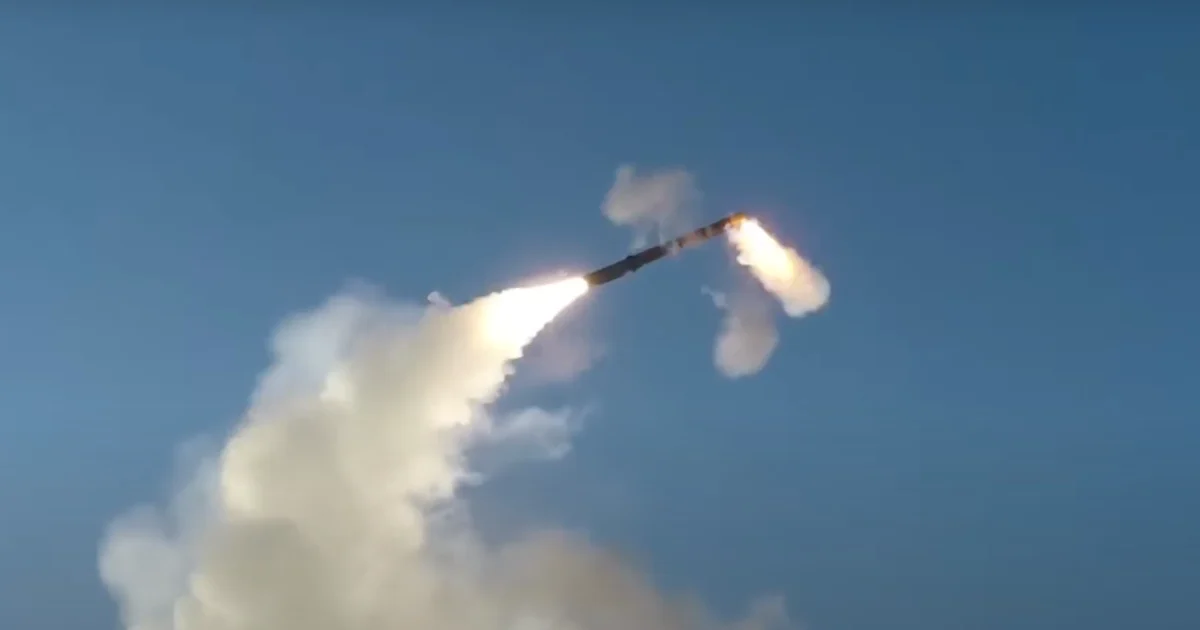
Russian missile (illustrative photo)
Russia is likely gearing up for a new season of testing its nuclear-powered cruise missile, the “Burevestnik”. Aircraft and vessels, potentially for monitoring test launches, have been detected in and around the Novaya Zemlya archipelago.
This is indicated by recent satellite imagery analyzed by The Barents Observer team.
Two Il-976 SKIP command and telemetry aircraft have arrived at the Rogachevo airbase on Novaya Zemlya. The first appeared last week, and the second between August 22nd and 23rd.
A modernized A-50U long-range radar detection aircraft was also observed at the base. The Il-976 SKIP is equipped with specialized tracking and monitoring equipment, including radiation detection systems.
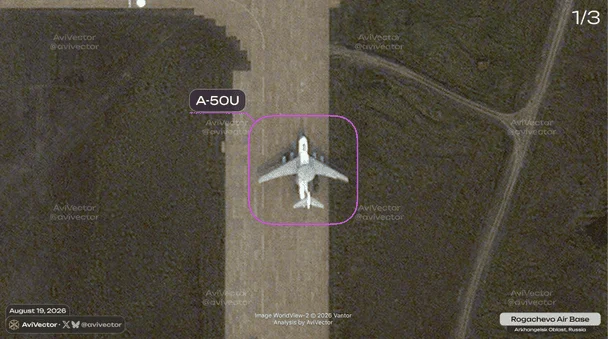
A modernized A-50U long-range radar detection aircraft was observed at the base / © AviVector
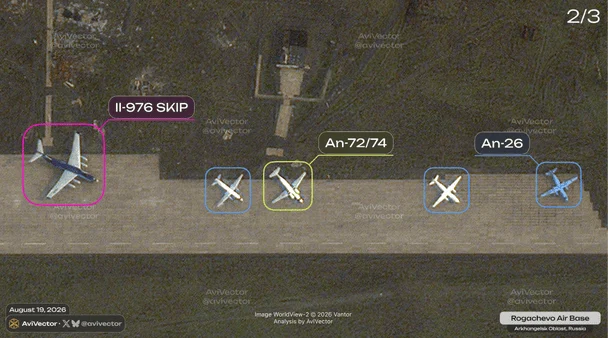
Two Il-976 SKIP command and telemetry aircraft have arrived at the Rogachevo airbase on Novaya Zemlya. / © AviVector
Aviation and ships deployed to the area
Currently, four An-26s, one An-74D, and helicopters, which may be used for transporting personnel to Pankovo and Severny – areas associated with the Russian testing ground – are also present at Rogachevo.
Over the past decade, Russia has constructed a special launch complex for “Burevestnik” testing in Pankovo, approximately 170 km from Rogachevo.
This week, a portion of the Barents Sea near the launch area was closed to flights. Similar restrictions on air and sea space near Novaya Zemlya have been implemented repeatedly from August to October.
Furthermore, ships have been observed on both the western and eastern sides of the archipelago. It is presumed they may be tracking test flights, the missile’s impact zone, and participating in its subsequent recovery.
“Burevestnik” allegedly flew for 15 hours
In October 2025, Chief of the General Staff of the Armed Forces of the Russian Federation Valery Gerasimov reported to Vladimir Putin about the alleged successful test of the “Burevestnik”. According to the Russian account, the missile flew approximately 14,000 kilometers and remained airborne for about 15 hours.
Subsequently, the Norwegian military intelligence confirmed the fact of the test flight.
Putin first publicly unveiled the “Burevestnik” in 2018 as a missile with virtually unlimited range and the ability to maneuver to evade anti-missile defense systems.
Risk of radioactive contamination exists
A distinctive feature of the “Burevestnik” is its use of a nuclear power plant. It is believed that the highly enriched uranium reactor may operate on an open-air cooling system.
Consequently, tests of such a missile could potentially be accompanied by radioactive substance releases.
In August 2019, during activities linked to this program, an explosion occurred near the Nyonoksa test range in the White Sea. Five Rosatom employees died at the time, and elevated radiation levels were temporarily recorded in Severodvinsk.
Following the incident, “Burevestnik” tests were relocated to Novaya Zemlya, where Russia continued to develop the necessary infrastructure.
Previously, it was reported that Russia had commissioned its new Project 09851 “Khabarovsk” nuclear-powered submarine into service for the first time. The submarine is equipped with six launchers for “Poseidon” nuclear torpedoes.
Related Topics
Russia Nuclear weapons Weapons Comments Sort by: New Old Popular Send