

Hundreds of meters underground in a mysterious cave, researchers have stumbled upon an ancient structure that is forcing the scientific world to fundamentally re-evaluate the history of evolution and acknowledge the incredible.
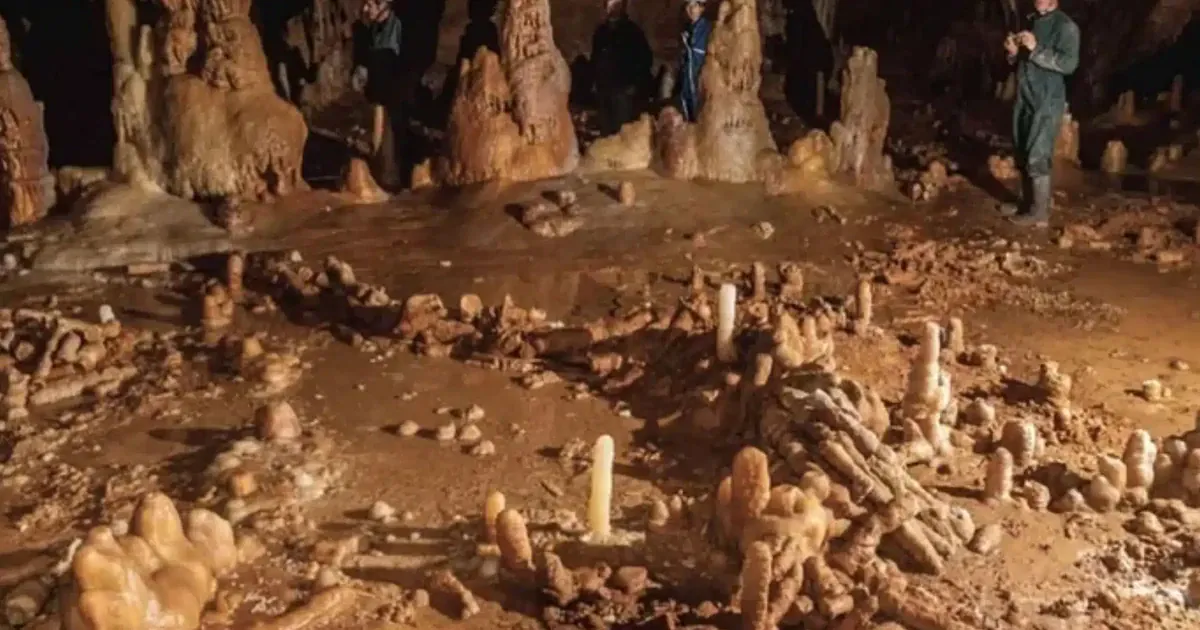
Neanderthal structure in Bruniquel Cave. Photo: Etienne Fabre/Speleological and Archaeological Society of Cosquer, France (SSAC)
At a depth of nearly 336 meters in the impenetrable darkness of France’s Bruniquel Cave, archaeologists have discovered massive rings skillfully constructed from stalagmite fragments. These remarkable structures are approximately 176,500 years old, presenting an unprecedented historical puzzle regarding who could have erected such a complex architectural object long before the emergence of modern humans.
This is reported by the Daily Galaxy.
Scale and Architectural Precision
This discovery is striking not only for its venerable age but also for the meticulous and deliberate manner in which it was built. To simply reach this hidden chamber, the unknown creators had to traverse hundreds of meters in complete darkness, which would have been impossible without the use of reliable artificial light sources.
Two ring-shaped structures are located in the largest chamber of the cave and are entirely composed of stalagmites broken from the subterranean floor. The larger ring measures 6.7 by 4.5 meters, while the smaller one reaches 2.2 by 2.1 meters. In total, the unknown architects used approximately 400 stone fragments weighing over two tons.
What surprised experts the most was the striking uniformity of the building material. Most fragments are about 30 centimeters long, indicating a deliberate breaking of stones to a uniform size before arranging them into precise circular formations.
Dating Errors and a Shocking Verdict
Initially, the authorship of this underground structure was not so obvious to the scientific community, as a burnt bone fragment found in the 1990s indicated an age of about 47,600 years. This left the theoretical possibility that early Homo sapiens were involved in the construction.
However, in 2016, new uranium-thorium dating of the calcite itself pushed the age of the structure back to 176,500 years. Since modern humans had not yet reached Europe at that time, the only possible creators of these rings could have been Neanderthals, although it was previously believed they were incapable of such construction.
Mystery of Purpose and Stereotype Shattering
For decades, Neanderthals were considered rather primitive beings, lacking skills in planning, cooperation, and symbolic thinking. Thus, the discovery in Bruniquel Cave was a true shock: all evidence unequivocally points to them, but science was reluctant to believe they could have created something so complex and thoughtful.
The exact purpose of these enigmatic rings remains a subject of fervent debate among world archaeologists. Some researchers suggest the structures served as a form of shelter during harsh ice ages, while others lean towards a ritualistic function, considering the construction an early analogue of a temple.
Traces of black and red hues remain on many fragments, indicating targeted fire effects. As the study’s authors note, this is the first recorded evidence that a pre-modern human species could master a deep karst environment with complex artificial lighting.
This discovery deals a final blow to the myth of our ancient predecessors’ short-sightedness. The scale of the work performed unequivocally proves that this group of builders possessed an incredibly high level of social organization and abstract thinking, previously confidently attributed solely to Homo sapiens.
Recall that cave paintings created during the Ice Age might not have been mere depictions of animals but a complex system of information transfer. Archaeologists reached this conclusion after analyzing over 500 drawings in the caves of the Basque Country.
Comments Sort: New Old Popular Send